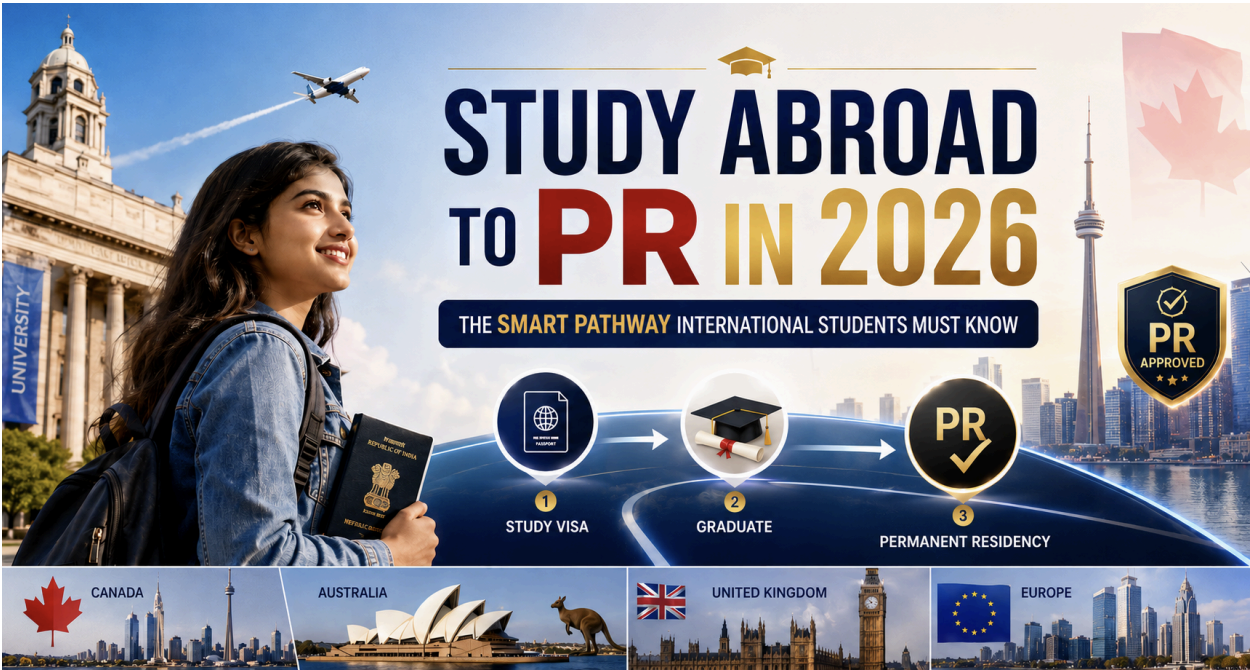
Study Abroad to PR in 2026: The Smart Pathway International Students Must Know
For many Indian students, studying abroad is no longer just about earning an international degree. It’s about building a long-term future — better job opportunities, global exposure, and in some cases, a pathway to Permanent Residency (PR).
That’s why one of the biggest questions students and parents ask today is:
“Can studying abroad eventually help me get PR?”
The answer is yes, in some countries it can — but only if you choose the right country, right course, and right long-term strategy. A student visa does not automatically lead to PR, and not every country offers an equally strong study-to-settlement route.
If you’re planning to study abroad in 2026, this guide will help you understand how the study abroad to PR journey works, which countries are worth considering, and what students should keep in mind before making a decision.
What Does “Study Abroad to PR Pathway” Mean?
A study abroad to PR pathway means using education as the first step toward long-term settlement in another country.
In simple terms, the journey usually looks like this:
- Study abroad on a student visa
- Complete your course
- Get post-study work rights
- Gain local work experience
- Meet PR eligibility requirements
- Apply for permanent residency
This is why many students search for terms like student visa to PR pathway, PR after study abroad, or post-study work to PR.
Student Visa vs Post-Study Work vs PR
These are three different stages:
- Student Visa / Study Permit – allows you to study in the country
- Post-Study Work Permit – allows eligible graduates to stay back and work after finishing their course
- Permanent Residency (PR) – gives long-term rights to live and work in that country
Important: PR Is Never Guaranteed
Even in countries with strong international student PR pathways, PR depends on several factors such as:
- Age
- Education Level
- Local Work Experience
- English or Local Language Ability
- Occupation Demand
- Salary or Points Requirements
- Province/State Nomination in some countries
- Immigration Rule Changes
So yes, studying abroad can lead to PR, but it depends on your profile and the country’s immigration system.
Why Students Are Thinking About PR Before Choosing a Study Destination
In 2026, students and parents are no longer looking only at tuition fees or university rankings. They also want to know whether the destination offers a long-term future.
Here’s why the study abroad PR pathway 2026 topic matters so much:
1. High Cost of Studying Abroad
Since overseas education is expensive, families want better return on investment (ROI).
2. Better Career Opportunities
Countries that allow post-study work can help students gain international experience and improve their job prospects.
3. Long-Term Settlement Goals
For some students, the dream is not only to study abroad but also to build a life there after graduation.
Best Countries Where Study Abroad Can Lead to PR
Not every country offers the same route from study permit to PR. Some countries have stronger and more practical options than others.
Canada: One of the Strongest Study-to-PR Destinations
Canada is one of the most popular choices for Indian students because it offers a clear connection between study, work, and PR.
Typical Canada pathway:
Study Permit → Graduate from an eligible program → Post-Graduation Work Permit (PGWP) → Gain Canadian work experience → Apply for PR
Common PR-linked routes:
- Express Entry
- Canadian Experience Class (CEC)
- Provincial Nominee Programs (PNPs)
Why Canada stands out:
- Strong post-study work options
- Multiple PR pathways
- Welcoming environment for international students
Important note:
Not every college or course guarantees a PR route. Your program eligibility, province, occupation, and work experience matter a lot.
Australia: Strong Potential, but More Competitive
Australia is another top destination for students who want education plus a possible PR pathway.
Typical Australia pathway:
Student Visa → Graduate → Post-study work rights → Skilled work → PR if eligible
PR in Australia depends heavily on:
- Occupation List
- Points System
- Age
- English Score
- Skilled Work Profile
- Regional Study/Work Options
- State Nomination
Why students choose Australia:
- Globally Recognized Education
- Strong Job Market in Selected Fields
- Good Opportunities in Healthcare, Engineering, IT, and Teaching
Important note:
Australia can be a strong PR after study abroad option, but it works best for students in in-demand occupations.
UK: Great for Education, But Not the Most Direct PR Route
The UK is a highly respected study destination, but students should understand that it is not the same as Canada when it comes to PR.
Typical UK pathway:
Student Visa → Graduate Route → Skilled job → Sponsored work visa → Long-term settlement if eligible
What students should know:
- The UK’s Graduate Route allows eligible students to stay and work after study
- The Graduate Route itself is not PR
- Students usually need to move into a longer-term skilled work route if they want settlement later
Best for:
Students who want top-quality education, shorter master’s programs, and global career exposure, while understanding that PR in the UK is not automatic.
Europe Study to PR Pathways: Which Countries Are Worth Considering?
Europe is not one single PR system. Every country has its own student work rights, job market, and long-term residence rules.
Germany: Strong Option for Career-Focused Students
Germany is one of Europe’s best destinations for students who want affordable education and long-term job opportunities.
Why Germany works:
- Low-cost or affordable education
- Strong economy
- Demand in engineering, IT, manufacturing, and research
Typical Germany pathway:
Study → Graduate → Stay-back/work search period → Skilled job → Long-term residence / PR if eligible
Important note:
German language can make a big difference in finding jobs and settling long-term.
Ireland: A Good English-Speaking European Choic
Ireland has become increasingly popular because it offers English-speaking comfort plus strong industries in tech, pharma, and business.
Typical Ireland pathway:
Study → Post-study work permission → Employment → Longer-term residence route if eligible
Why students like Ireland:
- English-speaking environment
- Good employer presence
- Practical work opportunities after graduation
Malta, Latvia, Slovakia & Croatia: Choose Carefully
These countries may look attractive because of affordability or lower tuition, but students should not choose them only because someone said PR is easy.
These countries may suit students who want:
- Lower-cost education
- Emerging European study destinations
- Specific niche programs
But students must check:
- Job Opportunities After Graduation
- Language Barriers
- Long-Term Work Rights
- Realistic PR Options
For most students whose main goal is a strong study-to-PR pathway, Canada, Australia, Germany, and Ireland are often stronger choices than smaller European destinations.
What Decides Whether a Student Can Move From Study Permit to PR?
The transition from study permit to PR depends on much more than just getting admission to a foreign college.
Key factors include:
- Country Chosen
- Course Relevance
- Institution Quality
- Post-Study Work Rights
- Local Job Opportunities
- Work Experience Gained After Graduation
- English or Local Language Ability
- Age and Immigration Points
- Occupation Demand
- Immigration Policy Changes
This is why two students studying abroad in the same country may have completely different PR outcomes.
Common Mistakes Students Make When Choosing a Study-to-PR Pathway
If PR is one of your long-term goals, avoid these common mistakes:
1. Choosing a country only because someone said PR is easy
What worked for someone else may not work for your profile.
2. Choosing a random course with no job demand
A low-cost or easy course may not help if it doesn’t improve your employability.
3. Assuming every diploma leads to PR
Not every course or institution gives the same post-study advantages.
4. Ignoring occupation demand
PR is often easier in sectors where the country actually needs workers.
5. Not understanding post-study work rules
Post-study work is often the bridge between education and PR. If you don’t understand it, your long-term plan can fail.
6. Believing agents who promise PR
No ethical consultant should guarantee PR just because you got admission.
How to Choose the Right Country if Your Goal Is PR After Study
If your aim is permanent residency after study, choose your destination strategically.
Ask these questions before finalizing a country:
- Is the course linked to real job demand?
- Does the country offer post-study work rights?
- Are there realistic PR pathways for international students?
- Is the cost of study worth the long-term ROI?
- Will language become a barrier in the job market?
- Is the country strong for my field, not just popular overall?
The smartest approach is to choose a country where education, work opportunities, and immigration pathways make sense together.
Is Studying Abroad Still a Smart PR Strategy in 2026?
Yes — for the right student, in the right country, with the right plan.
No — if a student blindly assumes that student visa = guaranteed PR.
The truth is simple: studying abroad can be a strong long-term strategy, but only when students plan beyond admission. The course, post-study work options, job demand, and PR pathway all need to be looked at together.
That’s why students in 2026 should not ask only:
“Which country should I study in?”
They should ask:
“Which country gives me the best future based on my course, career goals, budget, and PR plans?”
FAQs: Study Abroad to PR Pathway
Yes, in some countries it can — but PR depends on your course, work experience, occupation, language score, and immigration rules.
Canada is often one of the strongest options, followed by Australia, Germany, and Ireland depending on the student’s profile.
Yes, but students must choose the right course, eligible institution, and post-study work strategy
They may be able to, but it depends on occupation, points, English score, skills assessment, and work experience.
Not directly through study alone. Students usually need to move into a skilled work route after graduation.
Conclusion
Studying abroad can absolutely be the first step toward a long-term future abroad — but only when students make the decision strategically.
If your goal is PR after study abroad, don’t choose a country based only on tuition fees, popularity, or social media claims. Choose based on:
- Your career field
- Post-study work opportunities
- The country’s PR pathway strength
- Your budget and ROI
- Your ability to build a life there after graduation
The best study abroad to PR plan is not about chasing the “easiest PR country.” It’s about choosing the right country, right course, and right long-term pathway for your own profile.
Planning to study abroad in 2026 with long-term settlement goals? Speak to our study abroad experts for personalized guidance on country selection, course choice, post-study work options, and PR-focused study planning based on your profile, budget, and career goals.